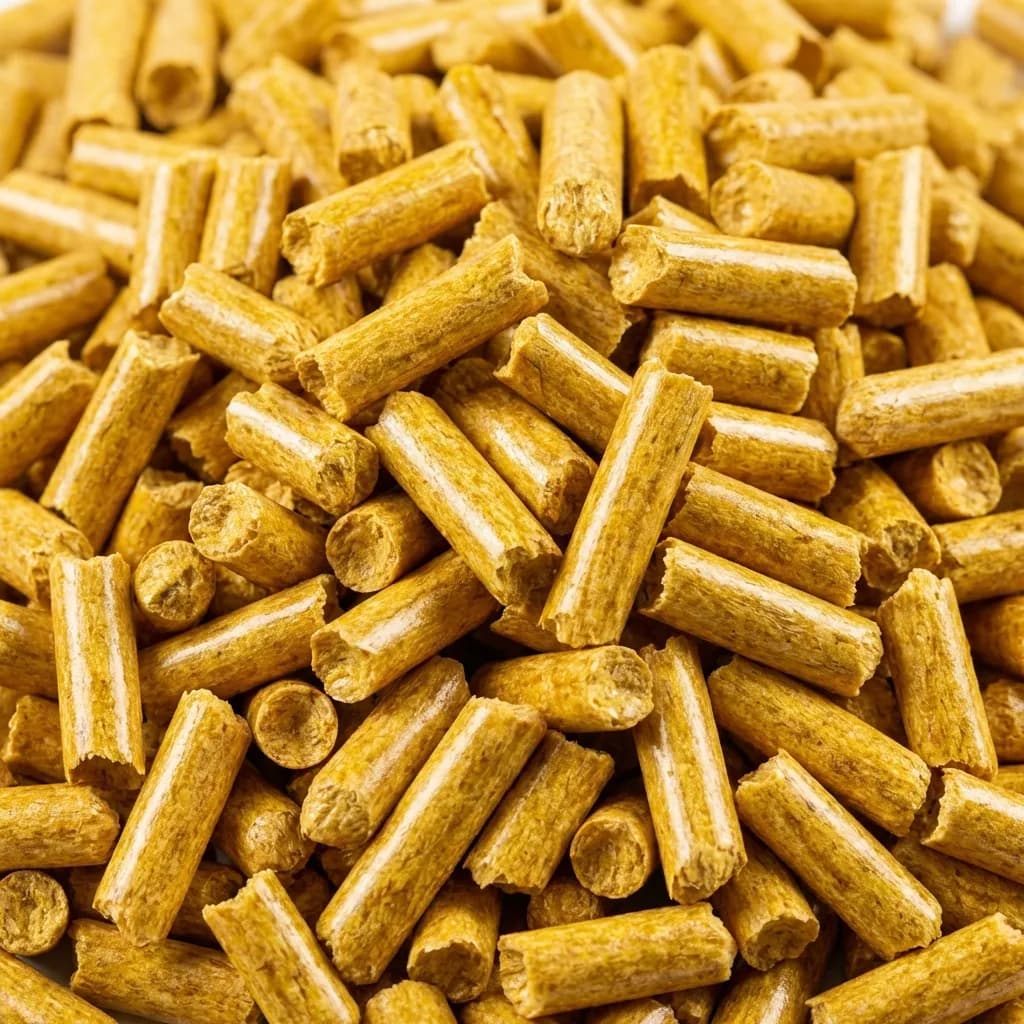
Pine Wood Pellets (ENplus A1)
Ask for the current price on WhatsApp
We do not publish this product's price on the site. Tell us how many bags or tons you need and your delivery address, and we will reply with the current price and a delivery day. This product cannot be added to the basket.
6 mm wood pellets made from 100% pine sawdust; the bag carries the ENplus A1 logo. For pellet stoves and automatic pellet boilers. Sold in 15 kg and 20 kg bags; orders of 1,200 kg or more are delivered as bags on pallets. Message us on WhatsApp for the current price and delivery.
Technical Specifications
What Are Pine Wood Pellets and How Are They Made?
Pine pellets are small cylindrical wood pellets made by drying and grinding pine sawdust and then forcing it through a die under high pressure. During pressing the wood heats up, its own lignin softens and holds the particles together, so what binds a pellet is largely the wood itself. ENplus allows pressing aids such as starch up to a total of 2%. The pellets leaving the die are cooled, screened to remove dust and then bagged.
Pine is a softwood (a conifer), which is why pine pellets are also called softwood pellets. The pine pellets we sell are made from 100% pine sawdust, are 6 mm in diameter and carry the ENplus A1 logo on the bag. We sell them in 15 kg and 20 kg bags; orders of 1,200 kg or more are delivered as bags on pallets. Thanks to their low moisture and standard size, a pellet stove feeds them automatically from its hopper with an auger.
Pine Pellet Price
We do not publish the pine pellet price on the site because it is not fixed; it changes with the factors below. We send the current pine pellet price on WhatsApp.
- Raw material
- Pellets are made from sawdust, a by-product of sawmills and the wood-processing industry. How available and how costly sawdust is feeds straight into the producer's price.
- Season
- Demand rises in the heating season, and in mid-season delivery times can lengthen too. If you have somewhere dry to keep the pellets, buying before the season makes things easier.
- Quantity and packaging
- The unit price for a few bags is not the same as for a pallet load. The choice between 15 kg and 20 kg bags also affects the price; orders of 1,200 kg or more are delivered as bags on pallets.
- Delivery distance
- Distance from our Ödemiş depot sets the delivery fee. There is no delivery fee in the free delivery area, or within İzmir Province on orders of 5 tons or more.
- Quality class
- Pellets with the ENplus A1 seal and uncertified pellets are not the same product; when comparing prices, look at the class and the certificate number.
When asking for a price, just tell us how many bags (15 kg or 20 kg) you want, your delivery address (district and neighbourhood) and, if you have one, your stove model.
Ask for the current pine pellet price on WhatsAppMore on the factors behind the price: What determines the price of pine pellets?
What to Check on a Bag of Pine Pellets
When buying pine pellets, look at what is printed on the bag rather than at the words "A1 quality". Under the ENplus rules (ST 1003) a certified bag carries:
- The ENplus quality seal: the ENplus logo, the quality class (A1 or A2) and the company's own ENplus ID (certificate) number together, on the front of the bag.
- The diameter: 6 mm or 8 mm. The pine pellets we sell are 6 mm.
- The net weight (kg) and the words "Wood pellets".
- The name and address of the company that owns the bag design.
- A serial (batch) number that identifies where and when the bag was filled.
- The notes "Store in dry conditions" and "Use only in appropriate combustion systems".
This information must be printed on the bag; a label stuck on afterwards or a handwritten number breaks the rules. You can look the certificate number up in the producer or trader list at enplus-pellets.eu and check for yourself that the company name matches and its status is "Active". The bags of the pine pellets we sell carry the ENplus A1 logo.
Step-by-step checklist: How to recognise ENplus A1 pellets
ENplus A1 Pine Pellets: Limit Values
The values below are the limits of the ENplus A1 class (ENplus ST 1001:2022, Annex A, Table 4). Pellets in a bag with the A1 seal must stay within them; they are not a laboratory result for this particular product.
| Property | ENplus A1 limit |
|---|---|
| Diameter | 6 ± 1 or 8 ± 1 mm |
| Length | 3.15 – 40 mm |
| Moisture (as received) | ≤ 10% |
| Ash (dry basis) | ≤ 0.7% |
| Mechanical durability | ≥ 98.0% |
| Fines (< 3.15 mm), bagged | ≤ 0.5% |
| Net calorific value (as received) | ≥ 16.5 MJ/kg (≥ 4.6 kWh/kg) |
| Bulk density | 600 – 750 kg/m³ |
| Additives | ≤ 2.0% |
The durability and fines limits are measured at the production and bagging point; some dust at the bottom of a bag after transport and stacking is normal.
Comparison with classes A2 and B, and with other fuels: Wood pellets in İzmir and our pellet guide
Pine Pellets or Oak and Beech (Hardwood) Pellets?
Conifers such as pine and spruce are softwoods; broadleaved trees such as oak and beech are hardwoods. Pellets are made from both. These are the differences that reliable sources support:
Heating value
Softwoods contain more lignin and resin, so per kilogram of dry wood their heating value is slightly higher than that of hardwoods. In the US Forest Products Laboratory's review the difference is about 5%, which is also how much individual samples vary. So the difference is real but small, and quoting an exact calorie figure for "pine pellets" against "oak pellets" would not be accurate.
Ash
Ash depends on the share of bark and the cleanliness of the raw material more than on the species: wood itself has about 0.6% ash, bark about 3%, and soil picked up during harvesting and storage adds more. ENplus does not allow raw material with a high amount of bark and limits ash in class A1 to 0.7%.
Density
As timber, oak and beech are denser than pine; for pellets, however, ENplus requires the same bulk density range (600–750 kg/m³) whatever the species.
Slag (clinker)
Slag in the burn pot is linked to high silicon and potassium in the ash; these elements are low in stem wood and higher in bark and foliage, and sand or soil contamination adds to them. ENplus A1 also requires an ash deformation temperature of at least 1200 °C.
In short, the class decides how pellets burn more than the species does. The ENplus classes are not defined by tree species but by measured properties such as ash, moisture, durability, fines and calorific value. Class A1 pellets may only be made from stem wood and chemically untreated by-products of the wood-processing industry (sawdust, chips). So before asking "pine or oak?", check the class and certificate on the bag, and then your appliance's manual.
The detailed comparison: Pine pellets or oak and beech pellets?
Which Appliances Burn Pine Pellets?
Pine pellets are burned in pellet stoves and automatic pellet boilers. These appliances take the fuel from a hopper with an auger and supply combustion air with a fan, so they need a power supply and stop when the power goes off. Pellets do not burn properly in a classic cast-iron stove, a cookstove or a fireplace; that is what the note "use only in appropriate combustion systems" on ENplus bags is for.
The appliance manufacturer decides which diameter and quality class to use, and the manual says so: domestic pellet stoves mostly ask for 6 mm. If your manual says 8 mm, ask the manufacturer before buying 6 mm pellets. Efficiency is a property of the appliance, not of the fuel; the figure is on your stove's label. If you are unsure, send us the make and model on WhatsApp and we will check it with you.
Looking for a stove? automatic pellet stove
To work out how long a bag lasts in your own appliance: How much heat do pine pellets give, and how long does a bag burn?
How to Store Pine Pellets
- Keep the bags on pallets in a closed, dry, well-ventilated room (basement, garage, shed), protected from moisture and direct sunlight.
- Do not put the bags straight on concrete or soil, and do not lean them against an outside wall.
- Open only the bag you are about to use, and close the top of an opened bag.
- Pellets that take up moisture swell, crumble and turn to dust, which can block the feed auger. Do not put wet pellets in the stove.
- If your order arrived on pallets, move the pallets to a closed, dry place as well; do not leave them outdoors where rain can reach them.
Storage and working out a season's needs: How to store pellets, and how many you need for a winter
Ordering Pine Pellets and Delivery
- Our depot is in Ödemiş, İzmir. We deliver pine pellets to addresses within 350 km by road of Ödemiş.
- Ödemiş, Tire, Bayındır, Kiraz and Beydağ are in our free delivery area; we charge no delivery fee there. Bozdağ, Birgi and Çaylı, which belong to Ödemiş, are in it too.
- Within İzmir Province delivery is free on orders of 5 tons or more. Elsewhere the delivery fee depends on quantity and distance; we tell you the amount on WhatsApp.
- To order, tell us on WhatsApp (+90 531 585 62 29) how many bags (15 kg or 20 kg) you want and your address; we reply with the current price and a delivery day. Orders of 1,200 kg or more are delivered as bags on pallets. Pine pellets cannot be added to the cart and their price is not shown on the site.
Pine Wood Pellets — Frequently Asked Questions
What are pine pellets?
Pine pellets are wood pellets pressed from dried, ground pine sawdust. They are burned in pellet stoves and automatic pellet boilers. The pellets we sell are 100% pine and 6 mm, and the bag carries the ENplus A1 logo.
How many calories do pine pellets give?
ENplus requires a net calorific value of at least 16.5 MJ/kg as received, that is at least 4.6 kWh/kg (about 3,950 kcal/kg), in all its classes. That is a lower limit, not a laboratory result for one product; we do not publish a calorie figure of our own. Softwoods such as pine have a slightly higher heating value per kilogram of dry wood than hardwoods, but the difference is small.
Are pine pellets better than oak or beech pellets?
The quality class matters more than the tree species. The ENplus classes are defined by ash, moisture, durability and calorific value, not by species. Pine, as a softwood, has a slightly higher heating value in dry wood; ash depends on bark content and the cleanliness of the raw material. Look first at the class and certificate number on the bag, then at your appliance's manual.
Do pine pellets leave a lot of ash or slag?
In ENplus class A1, ash is limited to 0.7% (dry basis) and the ash deformation temperature must be at least 1200 °C. Ash and slag come mainly from bark, soil and sand in the raw material rather than from the species. If you see much more ash or slag than usual, check that the pellets have not taken up moisture and that the burn pot is cleaned as the manual says.
Which pellets should I use in a pellet stove, 6 mm or 8 mm?
Use the diameter and quality class given in your stove's or boiler's manual. Domestic pellet stoves mostly use 6 mm; the pine pellets we sell are 6 mm. If your manual says 8 mm, ask the manufacturer before buying.
What is the price of pine pellets? How much is a ton?
We do not publish the pine pellet price on the site, because it changes with raw material, season, quantity and delivery distance. Tell us on WhatsApp (+90 531 585 62 29) how many bags (15 kg or 20 kg) you want and your address, and we will send the current price and a delivery day.
How many bags are there in a ton of pine pellets?
One ton is about 67 bags of 15 kg, or 50 bags of 20 kg. We sell pine pellets in 15 kg and 20 kg bags; orders of 1,200 kg or more (80 bags of 15 kg, or 60 bags of 20 kg) are delivered on pallets.
How should pine pellets be stored?
Keep the bags on pallets in a closed, dry, well-ventilated place, away from moisture and direct sunlight, and open only the bag you are about to use. Pellets that take up moisture swell and crumble and can block the stove's feed system.
Sources
- ENplus ST 1001:2022 — ENplus wood pellets, Requirements for companies (Annex A, Table 4)
- ENplus ST 1003:2022 — Usage of the ENplus trademarks (mandatory information on the bag)
- ENplus list of certified producers
- ENplus list of certified traders
- A. J. Baker (USDA Forest Products Laboratory), "Wood fuel properties and fuel products from woods", 1983 — heating value of softwoods and hardwoods, ash content of wood and bark
- Penn State Extension, "Manufacturing Fuel Pellets from Biomass" — lignin as the natural binder
- Lindström et al. (2010), Energy & Fuels 24(6) — slagging of wood pellets and the role of bark and contamination
- ENplus GD 3001:2023, "Storage for Wood Pellets" — storing bagged pellets
- US EPA Burn Wise, "Pellet Stoves" — how pellet stoves work
More about pellets
Our bags carry the ENplus A1 logo. We do not publish the pellet price on the site; message us on WhatsApp for the current price and delivery day.
Price on WhatsApp