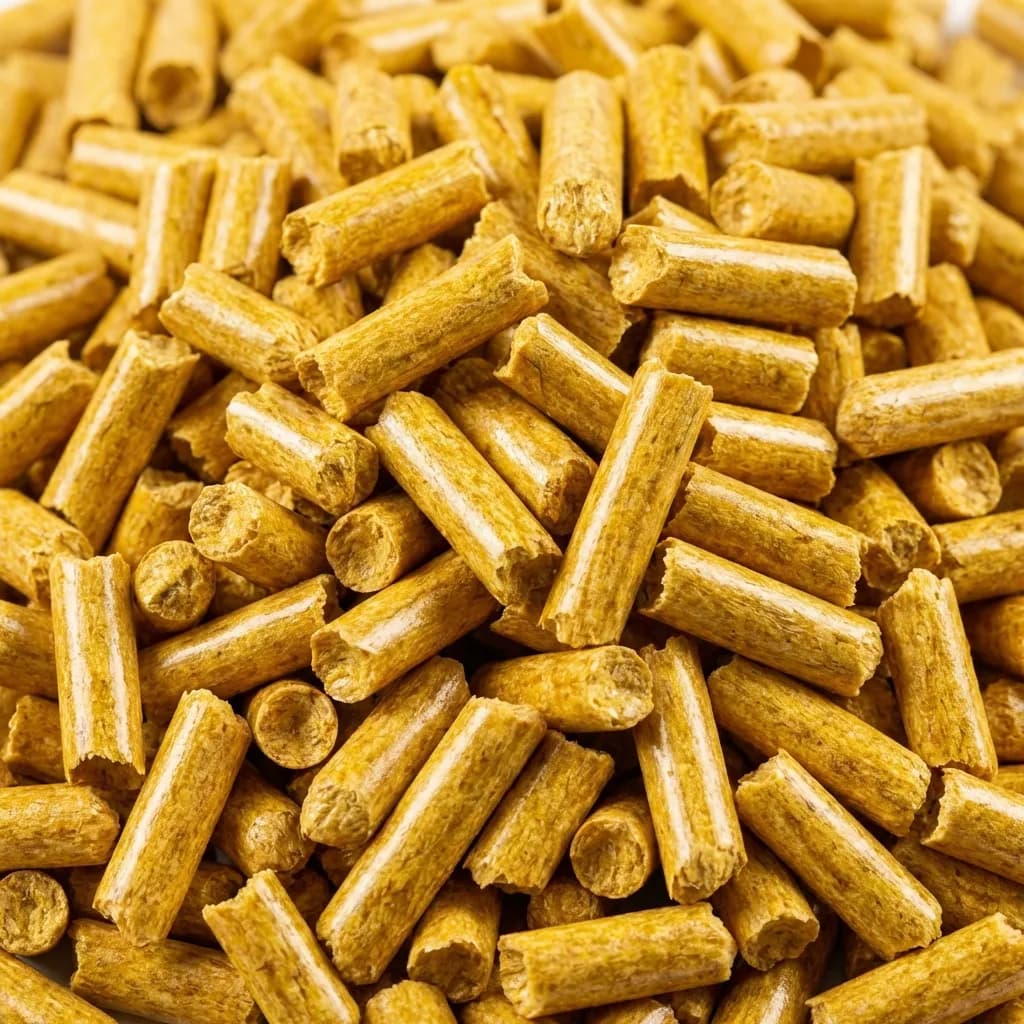
Pellets are a trouble-free fuel as long as they stay dry. Once wet, they swell, crumble and turn to dust, which can block a pellet stove's feed auger and burn pot. This article covers how to store pellets and then how to estimate how many your home needs for a winter.
How to store pellets
- Keep them indoors and dry. The "store in dry conditions" note is mandatory on ENplus bags; it is the most important condition for using pellets.
- Keep them off the floor. Concrete and soil draw moisture upwards. Stack bags on a pallet or boards.
- Do not lean them against walls. Outside walls in particular can collect condensation; leave a gap.
- Close opened bags. An open bag in damp air absorbs moisture.
- Keep them away from heat sources such as the stove or boiler.
- Do not use wet pellets. Swollen, crumbling pellets should not go in the stove, nor be mixed with dry ones.
If you must store them on a balcony, use a closed cabinet or cover that fully protects the bags from rain and snow and keeps them off the floor; the bag's plastic alone is not enough on an open balcony.
How many pellets for a winter?
Anyone who gives you a single number is guessing: two homes of the same size can use very different amounts depending on insulation, climate and habits. The right method uses three quantities:
Pellets (kg) = seasonal heat demand (kWh) ÷ (net calorific value of the pellets in kWh/kg × appliance efficiency)
1. Seasonal heat demand (kWh)
This is the most uncertain figure and it is specific to your home. The best data is your own past consumption: if you know how much fuel you burned last winter, work backwards from it. If not, our fuel calculator gives a rough estimate from floor area, insulation and heating type.
2. Calorific value of the pellets (kWh/kg)
For ENplus A1, A2 and B the net calorific value as received must be at least 4.6 kWh/kg (16.5 MJ/kg). Real pellets may be slightly higher; using the minimum makes the estimate cautious (slightly high).
3. Appliance efficiency
Efficiency is a property of the appliance and is given on your stove's or boiler's label and in its manual. Use your own appliance's figure.
Worked example (assumptions stated)
These numbers only illustrate the method; they are not your home's demand:
- Assumed seasonal heat demand: 8,000 kWh.
- Net calorific value of pellets: 4.6 kWh/kg (ENplus minimum).
- Appliance efficiency: assumed between 80% and 90%.
At 90%: 8,000 ÷ (4.6 × 0.90) ≈ 1,930 kg. At 80%: 8,000 ÷ (4.6 × 0.80) ≈ 2,170 kg. With these assumptions the seasonal need is about 1.9 – 2.2 tons, roughly 129 – 145 bags of 15 kg or 97 – 109 bags of 20 kg.
If your heat demand is half of 8,000 kWh, the pellets halve too; if it is double, they double. The value of the formula is that you can put in your own figures.
How much space does that take?
According to ENplus, the bulk density of pellets is 600 – 750 kg/m³, so 2 tons of loose pellets take up about 2.7 – 3.3 m³. Bagged pellets on pallets need a little more. If space is tight, split the season into two or three deliveries instead of taking everything at once.
When to buy
Delivery times can lengthen when demand rises mid-season, so stocking early helps if you have a dry place for the pellets. Without one, split deliveries are safer, because pellets kept a long time in poor conditions take on moisture.
For ENplus classes, how to recognise good pellets and comparisons with other fuels see our wood pellet page (in Turkish). We do not publish pellet prices on the site; tell us on WhatsApp how many bags or tons you need and your address, and we will reply with the current price and a delivery day.
Source: calorific value and bulk density limits from ENplus ST 1001:2022, Annex A, Table 4.
Current Price List
Starting prices for our coal, firewood and olive-pomace products. Pellet prices are quoted on WhatsApp.
| Product | Unit | Starting Price (incl. VAT) | Detail |
|---|---|---|---|
| Süper Enerji Sibirya Kömürü | 25kg Torba | ₺450 | View |
| Yerli Soma Kömürü | 25kg Torba | ₺216 | View |
| Kalorifer Kömürü (Ceviz) | 25kg Torba | ₺384 | View |
| Kalorifer Kömürü (Fındık) | 25kg Torba | ₺372 | View |
| Karpuz Kömür (Blok) | 25kg Torba | ₺336 | View |
| Yerli Linyit Kömürü (Parça) | 25kg Torba | ₺192 | View |
| Kök Kömür (Yerli) | 40kg Çuval | ₺348 | View |
| Pres Kömür (Briket) | 25kg Torba | ₺228 | View |
| Meşe Odunu (Kuru) | 1 Çuval (20-25kg) | ₺180 | View |
| Sarı Meşe Sobalık Odun | Çuvallı — 30 kg | ₺480 | View |
| Meşe Odunu (6 Aylık) | 1 Çuval (20-25kg) | ₺156(estimate) | View |
| Sarı Meşe Odunu (6 Aylık) | 1 Çuval (20-25kg) | ₺180(estimate) | View |
| Odun Peleti (Çam) | — | Ask on WhatsApp | View |
| Fındık Kabuğu Yakıtı | 25kg Çuval | ₺156 | View |
| Tahta Parçası (Çam) | Torba (17-23 kg) | ₺300 | View |
| Pirina (Zeytin Çekirdeği Yakıtı) | 25kg Çuval | ₺132 | View |
Prices include VAT and can change. Message us on WhatsApp for the current price and a quote including delivery.
Ask for a Price on WhatsApp