What Are Wood Pellets? How They Are Made and Where They Are Used
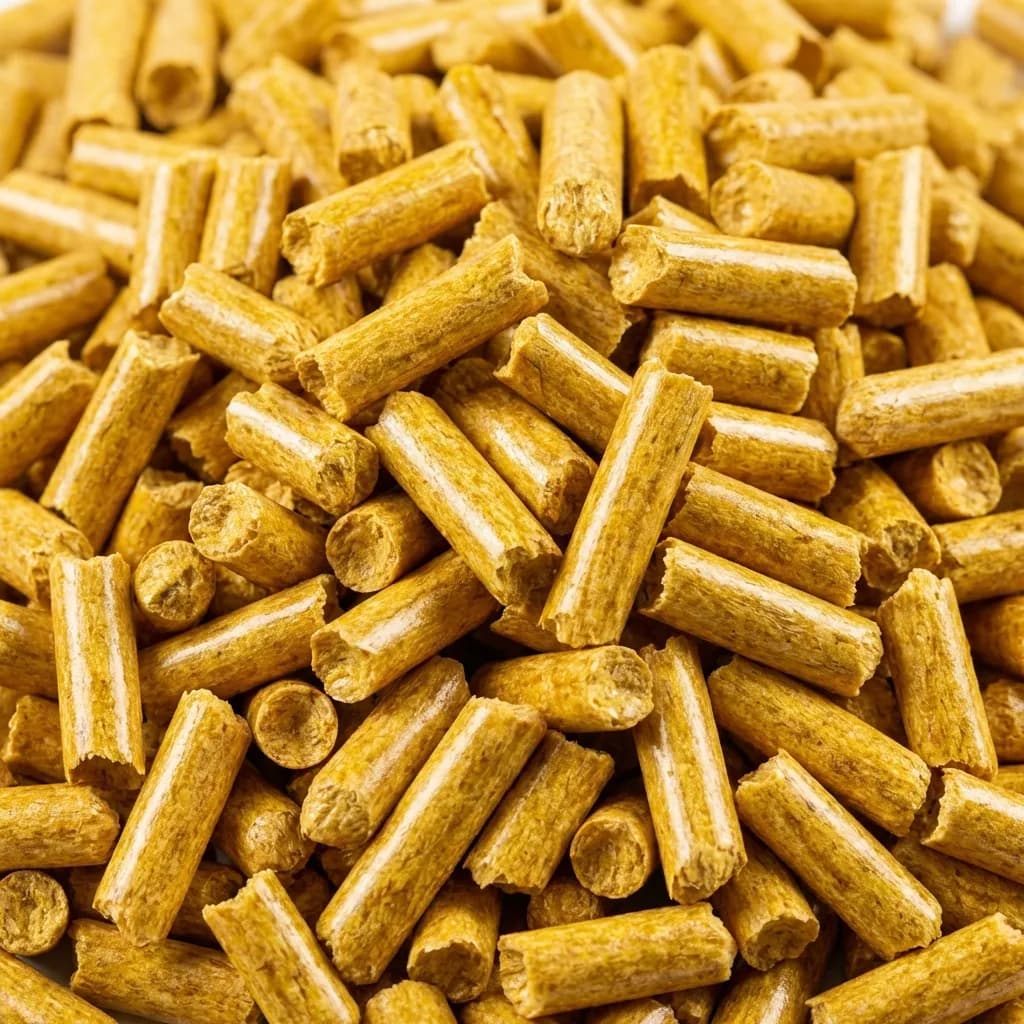
The short answer to "what are wood pellets?" is this: a solid fuel in the form of small cylinders, made by pressing sawdust. In this article we explain what wood pellets are made from and how, where they are used and where they are not, and what to check on the bag when you buy them. Price is not the subject here; we cover it in our article on wood pellet prices.
What are wood pellets?
Wood pellets are a fuel made by drying and grinding wood residues such as the sawdust and chips left over from sawmilling and woodworking, and then pressing them under high pressure. Pellets made for household appliances are 6 mm or 8 mm in diameter; under the ENplus rules their length is between 3.15 mm and 40 mm. Their moisture is low (at most 10% in the ENplus classes) and their size is standard; thanks to these two properties a stove can feed them automatically from its hopper with an auger.
"Pellets" and "wood pellets" mean the same product in everyday use. "Pine pellets" are one kind of wood pellet: their raw material is pine sawdust.
What are they made from?
The raw material of wood pellets is wood itself: sawdust, chips and similar residues. The class of the pellets decides which raw material may be used. ENplus class A1 pellets may only be made from stem wood and chemically untreated by-products of the wood-processing industry; raw material with a high amount of bark is not allowed. There is a practical reason: wood itself has about 0.6% ash while bark has about 3%; the more bark and soil, the more ash.
A product made from painted, varnished or glued wood waste (old furniture or chipboard, for example) is not ENplus A1 wood pellets. If a bag smells of anything other than wood (paint, chemicals, mould), do not use those pellets.
How are wood pellets made?
Production can be summed up in six steps:
- Preparation: Stones, metal and oversized pieces are removed from the raw material.
- Drying: The sawdust is dried to a moisture level at which it can be pressed. Sawdust that is too wet does not hold together as a pellet; sawdust that is too dry does not bind well either.
- Grinding: The dried material is ground fine enough, and evenly enough, to pass through the holes of the die.
- Pressing: The material is forced through a perforated die under high pressure. Heated by pressure and friction, the wood's own lignin softens and holds the particles together, so what binds a pellet is largely the wood itself. ENplus allows pressing aids such as starch up to a total of 2%.
- Cooling: Pellets leave the die hot and soft and are then cooled; they harden as they cool.
- Screening and bagging: Dust and broken pieces are screened out and the pellets are bagged. ENplus requires fines smaller than 3.15 mm to be at most 0.5% when the bags are filled.
Kinds of wood pellets
Wood pellets are named after the tree whose sawdust they are made from: softwood pellets from conifers such as pine, hardwood pellets from broadleaved trees such as oak and beech, and mixed pellets from the sawdust of more than one species. The difference between species is smaller than people assume: the ENplus classes are not defined by tree species but by measured properties such as ash, moisture, durability and calorific value. We make the detailed comparison in pine pellets or oak and beech pellets?
Where are wood pellets used?
- Pellet stoves: They heat a single room or an open-plan living area. A pellet stove takes its fuel from the hopper with an auger, supplies combustion air with a fan and holds the heat at the value set on the panel or thermostat.
- Pellet boilers: They are connected to the central heating system and can heat the whole house and the hot water. Outside the home, the same fuel is used wherever a pellet boiler is installed, such as workplaces, workshops and greenhouses.
Both appliances need electricity: the auger, the fan and the control board run on it, and the appliance stops during a power cut. The appliance manufacturer decides which diameter and quality class to use, and the manual says so.
Where are they not used?
Wood pellets do not burn properly in a classic cast-iron stove, a cookstove or a fireplace: these appliances have nothing to feed the fuel little by little and adjust the air to match. That is what the note "use only in appropriate combustion systems" on ENplus bags is for. The reverse also holds: firewood and coal do not go in a pellet stove. If you are still choosing a stove, see our article pellet stove or coal stove?
Strengths and limits
- Standard and predictable: In the ENplus classes the net calorific value is at least 4.6 kWh/kg and moisture at most 10%. With firewood the heating value varies a great deal with moisture; with pellets that range is narrow.
- Automatic feeding: You fill the hopper and the appliance feeds itself; there is no need to keep adding fuel.
- Tidy storage: The bags stack; unlike firewood they need no stacking yard and no drying time.
- Limit — a dedicated appliance and electricity: They cannot be used without a pellet stove or boiler, and the appliance does not work during a power cut.
- Limit — moisture: Pellets that take up moisture swell, crumble and turn to dust. A closed, dry place is essential; see how to store pellets.
A note on efficiency: efficiency is a property of the appliance, not of the fuel. There is no such figure as "these pellets are so many per cent efficient"; the figure is on your stove's label.
What to check on the bag when buying wood pellets
- The ENplus quality seal: the logo, the quality class (A1 or A2) and the company's own ENplus ID number must appear together, printed on the bag.
- The diameter (6 mm / 8 mm) must match the one in your appliance's manual.
- The net weight: how many kilograms is the bag? When comparing prices, look at the price per kilogram.
- When you open the bag there should be no clear layer of dust and not many broken pellets.
We explain step by step how to verify the certificate number in the official list in how to recognise ENplus A1 pellets.
The wood pellets we sell
The wood pellets we sell are made from 100% pine sawdust, are 6 mm in diameter and carry the ENplus A1 logo on the bag. We sell them in 15 kg and 20 kg bags; orders of 1,200 kg or more are delivered as bags on pallets. Product details are on our pine wood pellets page; the kinds of pellets, the limit values of the classes and the delivery areas are on our wood pellets in İzmir page. We do not publish the price on the site; you can ask for the current wood pellet price on WhatsApp (+90 531 585 62 29).
Sources: ENplus ST 1001:2022, Annex A, Tables 4 and 5 (limit values and the A1 raw material rule); A. J. Baker (USDA Forest Products Laboratory), "Wood fuel properties and fuel products from woods", 1983 (ash content of wood and bark); Penn State Extension, "Manufacturing Fuel Pellets from Biomass" (production steps, lignin as the binder); US EPA Burn Wise, "Pellet Stoves" (how pellet stoves work).
Current Price List
Starting prices for our coal, firewood and olive-pomace products. Pellet prices are quoted on WhatsApp.
| Product | Unit | Starting Price (incl. VAT) | Detail |
|---|---|---|---|
| Süper Enerji Siberian Coal | 25 kg bag | ₺450 | View |
| Domestic Soma Coal | 25 kg bag | ₺216 | View |
| Central Heating Coal (Walnut Size) | 25 kg bag | ₺384 | View |
| Central Heating Coal (Nut Size) | 25 kg bag | ₺372 | View |
| Block Coal (Large Lump) | 25 kg bag | ₺336 | View |
| Domestic Lignite Coal (Lump) | 25 kg bag | ₺192 | View |
| Root Coal (Domestic) | 40 kg sack | ₺348 | View |
| Pressed Coal (Briquettes) | 25 kg bag | ₺228 | View |
| Oak Firewood (Dry) | 1 sack (20-25 kg) | ₺480 | View |
| Yellow Oak Stove Wood | Bagged — 30 kg | ₺480 | View |
| Oak Firewood (6 Months Seasoned) | 1 sack (20-25 kg) | ₺156(estimate) | View |
| Yellow Oak Firewood (6 Months Seasoned) | 1 sack (20-25 kg) | ₺180(estimate) | View |
| Pine Wood Pellets (ENplus A1) | — | Ask on WhatsApp | View |
| Hazelnut Shell Fuel | 25 kg sack | ₺156 | View |
| Pine Kindling and Wood Pieces | Bag (17-23 kg) | ₺300 | View |
| Pirina (Olive Pit Fuel) | 25 kg sack | ₺132 | View |
Prices include VAT and can change. Message us on WhatsApp for the current price and a quote including delivery.
Ask for a Price on WhatsApp