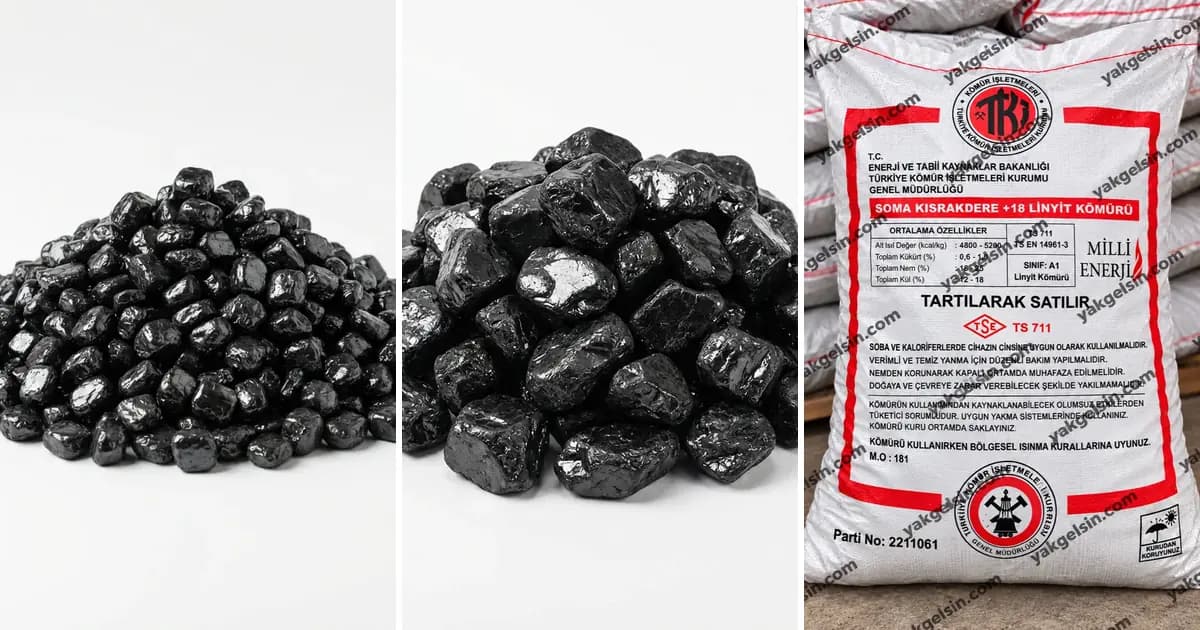
How Many Bags of Coal Does a Central Heating Boiler Burn per Day? Flat Boiler Coal Use
Prepared by: the Yak Gelsin teamLast updated:
Short answer: a boiler’s daily coal use is estimated by multiplying the home’s hourly heat demand (kW) by the hours the boiler runs, then dividing by the coal’s kWh/kg value times boiler efficiency. Example: an average 10 kW load, 16 hours, 7,400 kcal/kg coal and 75% efficiency burn about 25 kg, one bag, a day.
Boiler coal types: Heating coal →
There is no single answer: the same boiler may burn half a bag in an insulated flat and two bags in an old building. All examples are estimates based on stated assumptions, not measurements; the most accurate figure comes from measuring your own boiler. Which coal suits a boiler is a separate question: which coal for a central heating boiler.
How do you calculate daily coal consumption?
- Heat demand (kW): how much heat the home loses per hour on average. The output on the boiler label is for the coldest hours; average demand is lower.
- Operating hours: how long the boiler burns during the day.
- Calorific value of the coal: divide kcal/kg by 860 to get kWh/kg (1 kWh = 860 kcal). Our pea-size (fındık) heating coal is declared on the bag at 7,400 kcal/kg as received: 7,400 ÷ 860 ≈ 8.6 kWh/kg.
- Boiler efficiency: how much of the coal’s energy reaches the water. The EU Ecodesign regulation for solid fuel boilers requires, from 2020, seasonal efficiency of at least 75% for boilers of 20 kW or less and 77% above 20 kW. An old or poorly maintained boiler may do worse.
Formula: daily kg = heat demand (kW) × hours ÷ (kWh/kg × efficiency). For example 8.6 × 0.75 ≈ 6.45, so the boiler gets about 6.45 kWh of useful heat from each kilogram of this coal.
| Example (assumption) | Average heat demand (kW) | Running (hours) | Daily heat (kWh) | Daily coal (kg) | Bags |
|---|---|---|---|---|---|
| Small insulated flat, mild weather | 4 | 10 | 40 | 40 ÷ 6.45 ≈ 6.2 | ≈ 0.25 |
| Medium flat, mostly evenings | 6 | 12 | 72 | ≈ 11.2 | ≈ 0.45 |
| Large flat, cold week | 10 | 16 | 160 | ≈ 24.8 | ≈ 1 |
| Detached house, cold week | 20 | 16 | 320 | ≈ 49.6 | ≈ 2 |
| Small apartment-block boiler | 60 | 14 | 840 | ≈ 130 | ≈ 5.2 |
The same method gives the boiler’s upper limit: a 25 kW boiler at full output burns at most 25 ÷ 6.45 ≈ 3.9 kg an hour. Real use is lower.
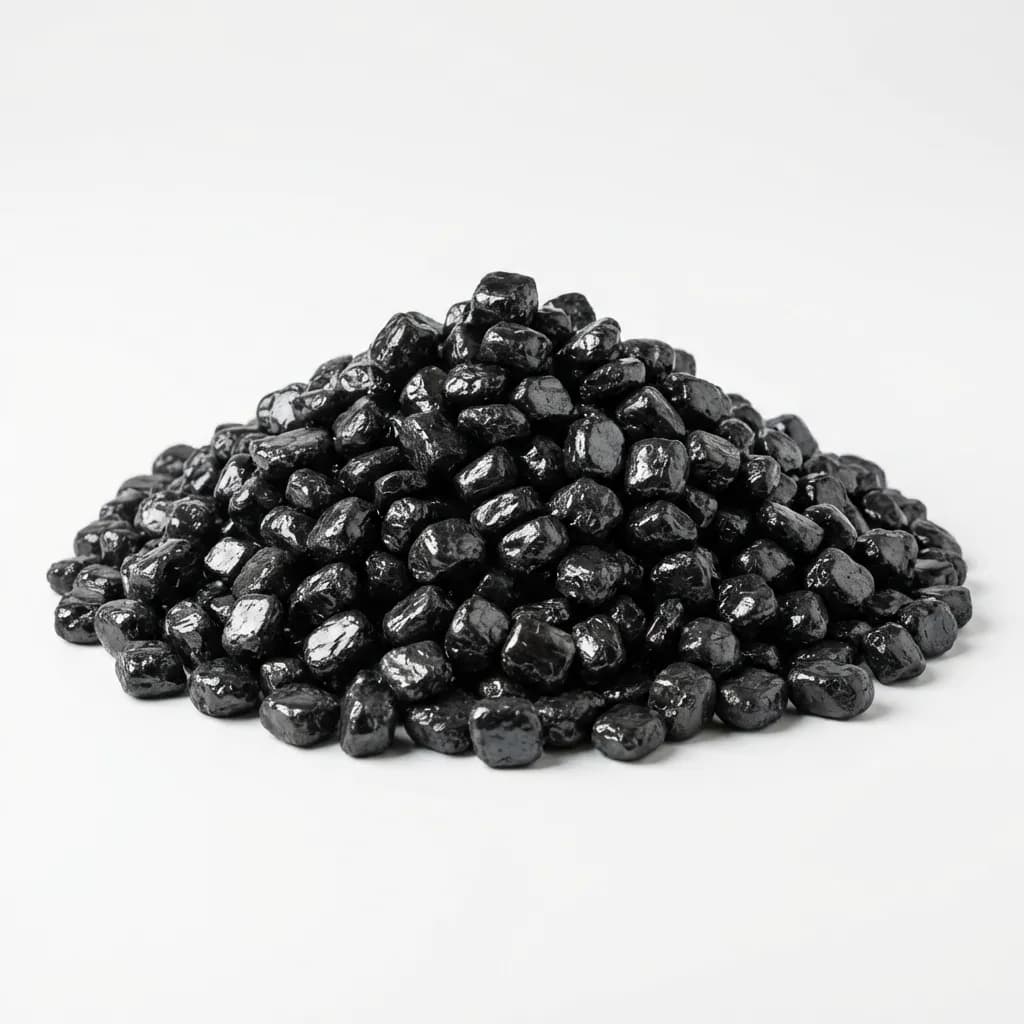
Central Heating Coal (Nut Size)
Calorific value (dry basis): 7800 - 8200 kcal/kg · Calorific value (as received): 7400 kcal/kg
How much do coal quality and boiler efficiency change the result?
Take one house needing 160 kWh of heat. The coal required is inversely proportional to calorific value and efficiency. For Soma lignite we took 5,000 kcal/kg, the middle of the 4,800–5,200 kcal/kg net value declared on the bag (5,000 ÷ 860 ≈ 5.81 kWh/kg). The 65% efficiency is an assumption standing for an old boiler.
| Coal (kcal/kg) | Efficiency (%) | Useful heat (kWh/kg) | Daily coal (kg) | Bags |
|---|---|---|---|---|
| 7,400 (heating coal) | 75 | 8.6 × 0.75 ≈ 6.45 | ≈ 24.8 | ≈ 1 |
| 7,400 (heating coal) | 65 | 8.6 × 0.65 ≈ 5.59 | ≈ 28.6 | ≈ 1.1 |
| 5,000 (Soma lignite) | 75 | 5.81 × 0.75 ≈ 4.36 | ≈ 36.7 | ≈ 1.5 |
| 5,000 (Soma lignite) | 65 | 5.81 × 0.65 ≈ 3.78 | ≈ 42.3 | ≈ 1.7 |
The U.S. EIA notes that lignite has the lowest energy content of all coal ranks, partly because of its high moisture. Lower-calorie coal therefore means more bags; which one is cheaper depends on price: how much does a ton of coal cost. For the difference between dry basis and as-received values on the bag: what the values on a coal bag mean.
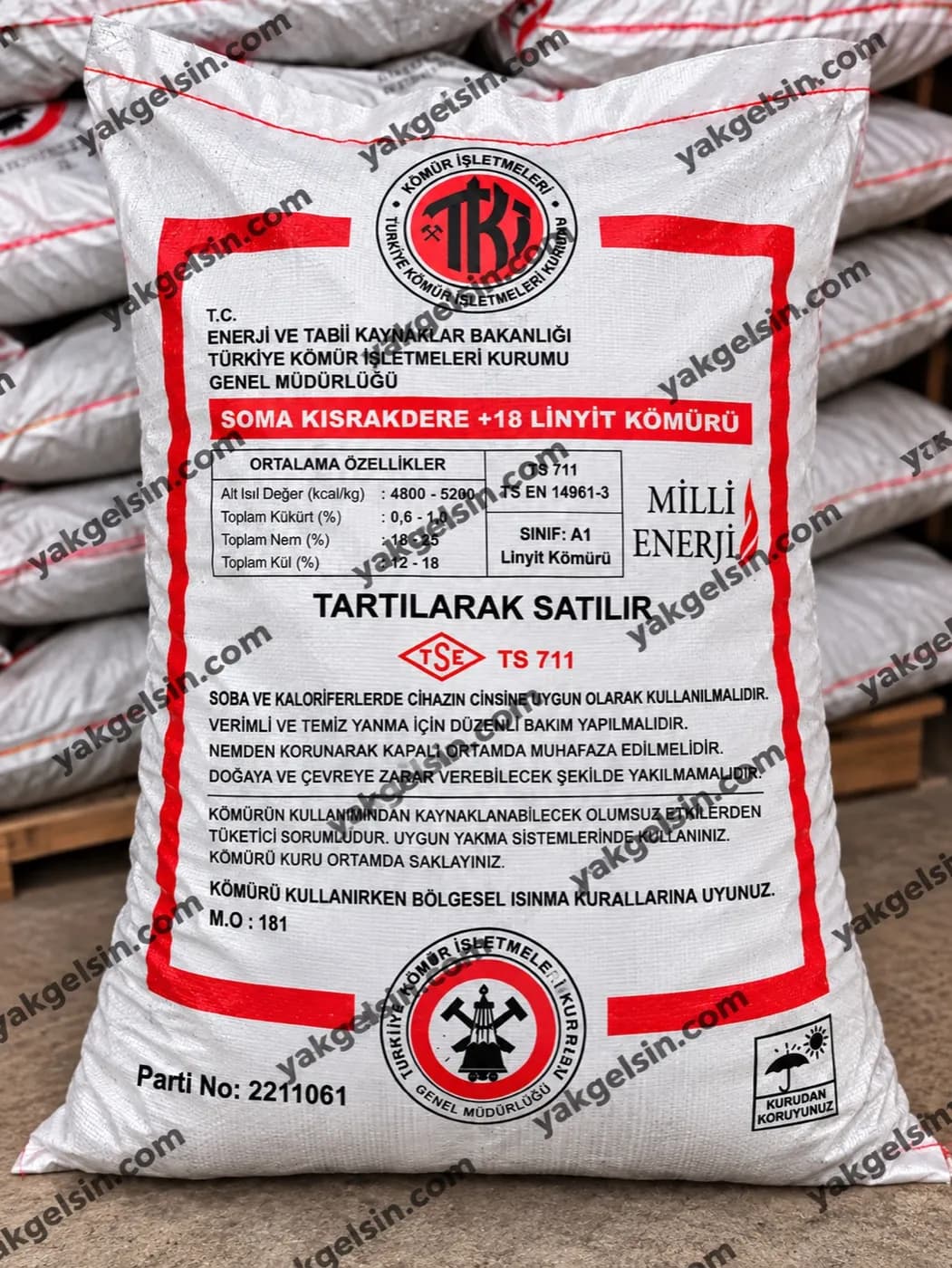
Producer: TKİ — Turkish Coal Enterprises · Type: Soma Kısrakdere +18 lignite
How much does consumption rise as it gets colder?
Turkey’s State Meteorological Service (MGM) calculates heating degree-days as (18 °C − Tm) when the daily mean temperature Tm is 15 °C or below, and states that heating cost is directly proportional to annual degree-days. Simplified: a day averaging 3 °C scores 15, a day averaging 10 °C scores 8, so the same house needs roughly 15 ÷ 8 ≈ 1.9 times as much heat on the colder day. So do not spread January’s use over the whole season.
What does it depend on?
- Insulation and windows: less heat loss means a lower average kW.
- Outdoor temperature: more degree-days, more coal.
- Calorific value and moisture of the coal: low kcal/kg or damp coal means more kilograms.
- Boiler efficiency and upkeep: sooted surfaces and badly set air pass less of the coal’s energy to the water.
- Thermostat and running hours: keeping rooms a degree or two cooler and turning the boiler down in empty hours cuts daily kWh.
- Coal size: coal of a size the boiler is not designed for burns poorly.
Pea or nut size for a boiler?
Size is chosen by boiler type rather than by consumption. Our pea-size (fındık) heating coal is screened to 10–18 mm for stoker (automatic feed) boilers; the nut-size (ceviz) heating coal is 30–50 mm for hand-fed boilers, and its current availability is shown on the product page. More: which coal for a central heating boiler.
How many tons of coal should you buy for a season?
Convert the daily estimate into weeks and the season. A boiler averaging 24.8 kg a day burns about 174 kg (7 bags) a week, so 1 ton lasts about 5.8 weeks at that rate. A flat burning 11.2 kg a day uses about 78 kg a week, and 1 ton lasts about 12.8 weeks. For the method and how to measure your own use see how much fuel should I buy, and for a ready estimate use our fuel calculator. For apartment and site managements buying by the ton: bulk coal and corporate supply.
How should coal be stored?
Keep the bags dry, covered and away from hot boiler surfaces; in damp coal part of the heat goes into evaporating water. On whether stored coal loses calorific value and more storage tips: how to store stove coal.
Safety note
No fuel is smokeless; every coal boiler produces carbon monoxide. The TKİ guide asks for the chimney to be swept at least once a year. Turkey’s Ministry of Health recommends a carbon monoxide detector wherever a fuel-burning heater is used; if headache, dizziness or weakness appear, ventilate, get out and call 112: CO symptoms and detectors.
Frequently asked questions
How many tons are 40 bags of coal?
With 25 kg bags, 40 × 25 = 1,000 kg, which is 1 ton. More: how many kg in a bag of coal.
How long does 1 ton of coal last in a boiler?
Divide 1,000 kg by weekly consumption. By our estimate it lasts about 5.8 weeks in a boiler burning one bag a day and about 11 weeks in one burning half a bag a day.
Does the kW on the boiler label show consumption?
No, it shows maximum output. Average demand is lower; full output only helps you calculate the upper limit.
Does higher-calorie coal burn less?
For the same heat, yes: 7,400 kcal/kg coal needs roughly a third fewer kilograms than 5,000 kcal/kg coal (5,000 ÷ 7,400 ≈ 0.68).
Sources: Commission Regulation (EU) 2015/1189, Annex II and Annex III; Turkish State Meteorological Service, Degree-days; U.S. EIA, Coal explained; Turkish Ministry of Health, Carbon monoxide poisoning; Ministry of Energy/TKİ, Guide to using coal in stoves.
Products in this article
- Central Heating Coal (Nut Size)Price on WhatsApp
- Domestic Soma CoalFrom, ₺180 excl. VAT, ₺216 incl. VAT
Current Price List
Starting prices for our coal, firewood and olive-pomace products: the amount excluding VAT, with the VAT-inclusive amount below it. Products without a listed price are quoted on WhatsApp.
| Product | Unit | Starting Price |
|---|---|---|
| Süper Enerji Siberian Coal | 25 kg bag | ₺375 excl. VAT, ₺450 incl. VAT |
| Domestic Soma CoalLimited stock | 25 kg bag | ₺180 excl. VAT, ₺216 incl. VAT |
| Cal Energy İmbat Coal — Grade 1Limited stock | 25 kg bag | ₺375 excl. VAT, ₺450 incl. VAT |
| Cal Energy İmbat Coal — Grade 2Limited stock | 25 kg bag | ₺350 excl. VAT, ₺420 incl. VAT |
| Cal Energy İmbat Nut Coal — Grade 1Limited stock | 25 kg bag | ₺375 excl. VAT, ₺450 incl. VAT |
| Cal Energy İmbat Nut Coal — Grade 2Limited stock | 25 kg bag | ₺350 excl. VAT, ₺420 incl. VAT |
| Central Heating Coal (Walnut Size)Made to order | — | Ask on WhatsApp |
| Central Heating Coal (Nut Size)Made to order | — | Ask on WhatsApp |
| Block Coal (Large Lump)Made to order | — | Ask on WhatsApp |
| Domestic Lignite Coal (Lump)Made to order | 25 kg bag | ₺160 excl. VAT, ₺192 incl. VAT |
| Root Coal (Domestic)Made to order | 40 kg sack | ₺290 excl. VAT, ₺348 incl. VAT |
| Pressed Coal (Briquettes)Made to order | — | Ask on WhatsApp |
| Oak Firewood (Dry) | 1 sack (20-25 kg) | ₺400 excl. VAT, ₺480 incl. VAT |
| Yellow Oak Stove Wood | Bagged — 30 kg | ₺400 excl. VAT, ₺480 incl. VAT |
| Red Oak Stove Wood | Bagged — 28 kg | ₺400 excl. VAT, ₺480 incl. VAT |
| Oak Firewood (6 Months Seasoned) | 1 sack (20-25 kg) | ₺400 excl. VAT, ₺480 incl. VAT |
| Yellow Oak Firewood (6 Months Seasoned) | 1 sack (20-25 kg) | ₺400 excl. VAT, ₺480 incl. VAT |
| 100% Pine Wood Pellets (ENplus A1) | 15 kg bag | ₺200 excl. VAT, ₺240 incl. VAT |
| Hazelnut Shell FuelMade to orderPrepaid | — | Ask on WhatsApp |
| Pine Kindling and Wood Pieces | Bag (17-23 kg) | ₺250 excl. VAT, ₺300 incl. VAT |
| Pirina (Olive Pit Fuel)Prepaid | 25 kg sack | ₺225 excl. VAT, ₺270 incl. VAT |
The top line of each price excludes VAT (+ VAT); the VAT-inclusive amount below it is what you pay. Prices can change. Message us on WhatsApp for the current price and a quote including delivery.
Ask for a Price on WhatsApp