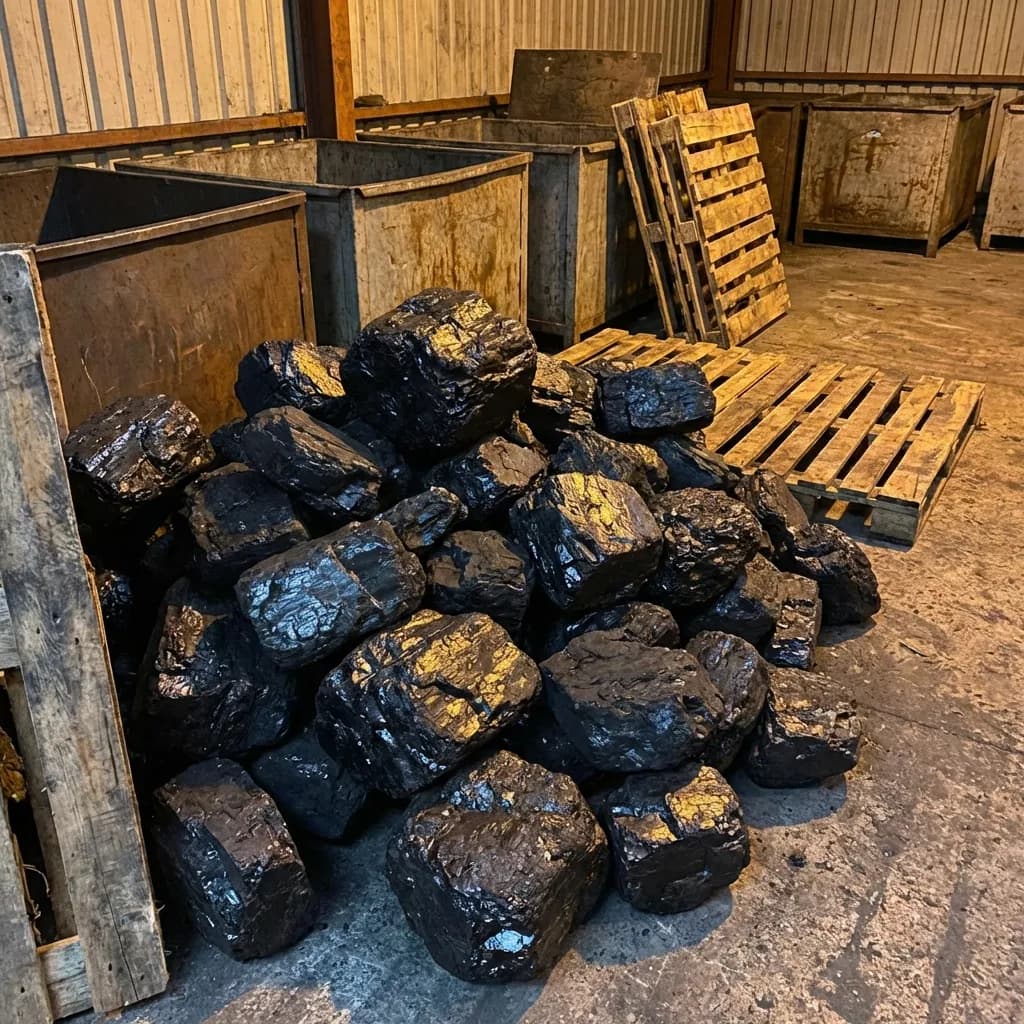
How Long Does Stove Coal Burn, and Does Stored Coal Lose Calories?
Prepared by: the Yak Gelsin teamLast updated:
Short answer: there is no single figure; a 25 kg bag lasts as long as your stove's hourly burn rate allows. On assumed figures, a stove burning 1 kg an hour empties the bag in 25 hours, one burning 2 kg in 12.5 hours. Stored coal can oxidise and lose heating value; keep it dry, covered, away from the stove.
Current prices and types: Coal prices →
How many hours does a bag of coal burn?
Duration = bag weight ÷ hourly consumption. Hourly use depends on the stove's air setting, the flue draught, the home's heat loss and the coal's heating value, so there is no official “kg per hour” figure; the rows below are not measurements but arithmetic on stated assumptions. For bag weights and how many bags make a tonne, see how many kg in a bag of coal.
| Assumed use (kg/hour) | Calculation | Bag lasts (hours) |
|---|---|---|
| 0.5 | 25 ÷ 0.5 | 50 |
| 1 | 25 ÷ 1 | 25 |
| 1.5 | 25 ÷ 1.5 | about 16.7 |
| 2 | 25 ÷ 2 | 12.5 |
| 3 | 25 ÷ 3 | about 8.3 |
How do you measure your own stove's consumption?
The most reliable figure is your own. Note when you open a new bag and when it runs out, add up the hours the stove burned and divide 25 kg by that number. Weekly works too: two bags a week means 2 × 25 = 50 kg a week; multiply by the weeks in your season for a rough total. Use rises in the coldest weeks. For season quantities, see how much fuel to buy and our fuel calculator.
Does stored coal lose its calorific value?
Yes, depending on conditions. The IEA Clean Coal Centre report on stockpile management says most coals, particularly lower-rank ones, are susceptible to weathering and atmospheric oxidation in open piles, leading to heating value losses. In an open-air trial with Indian thermal coal (Aich et al., International Journal of Coal Science & Technology), coal stored for about 11 months lost up to 55% of its original gross calorific value, ash rose from 29.2% to 46.6% and the coal became harder to ignite. That was an uncovered pile exposed to rain and humidity, not a measurement of bagged, dry coal, but it shows the direction: do not leave coal in the open for long.
What happens to coal when it sits?
- Oxidation: The coal surface reacts with oxygen in the air; as combustible matter falls, the ash share rises.
- Moisture and crumbling in lignite: The US Energy Information Administration (EIA) says lignite is crumbly and its moisture can be as high as 45%. With crumbly lignite, fines can build up at the bottom of the bag over time.
- Self-heating: A US Bureau of Mines study found that lignite and subbituminous coals can start self-heating at temperatures as low as 30 °C, while bituminous coals need about 60 °C or more. The hazard is greatest when dried coal is exposed to high humidity. The IEA report also stresses that spontaneous combustion is a safety problem in large stockpiles.
How should coal be stored?
- Dry and covered: HETAS advises keeping coal in a container made of suitable material, or in a pile covered with a tarp, away from the elements.
- Do not burn it wet: The same source says coal with surface water creates steam in the appliance; wait for the surface to dry. The TKİ guide also advises opening the bag a few days before use to air the coal.
- Off the ground: Do not stand bags on wet soil or concrete; keep them on a pallet or rack in a ventilated coal store.
- Away from heat: The US Fire Administration (USFA) says to keep anything that can burn at least 3 feet (about 90 cm) from heating equipment. Keep only what you will soon use inside the house.
Which coal burns longer?
The kilos needed for the same heat are inversely proportional to heating value. Between 7,400 and 4,800 kcal/kg, the ratio is 7,400 ÷ 4,800 ≈ 1.54: on the same basis and efficiency, you burn about 1.5 times the kilos of the lower-calorie coal. According to the bag declaration, Siberian coal is 7,000–7,800 kcal/kg on a dry basis and Soma coal 4,800–5,200 kcal/kg; since bases may differ, details are in how many calories coal should have.
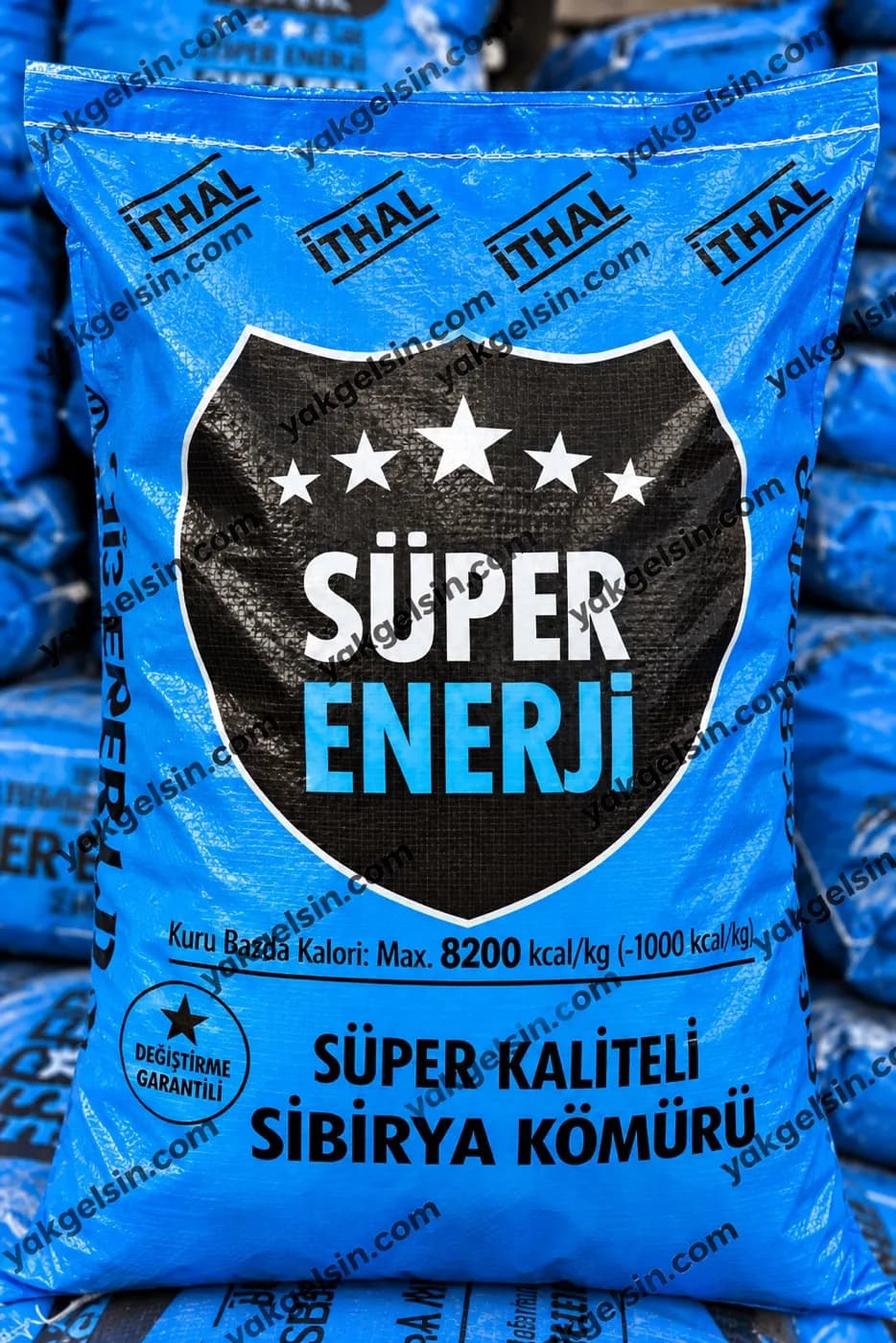
Brand: Süper Enerji · Calorific value (dry basis): 7000 - 7800 kcal/kg
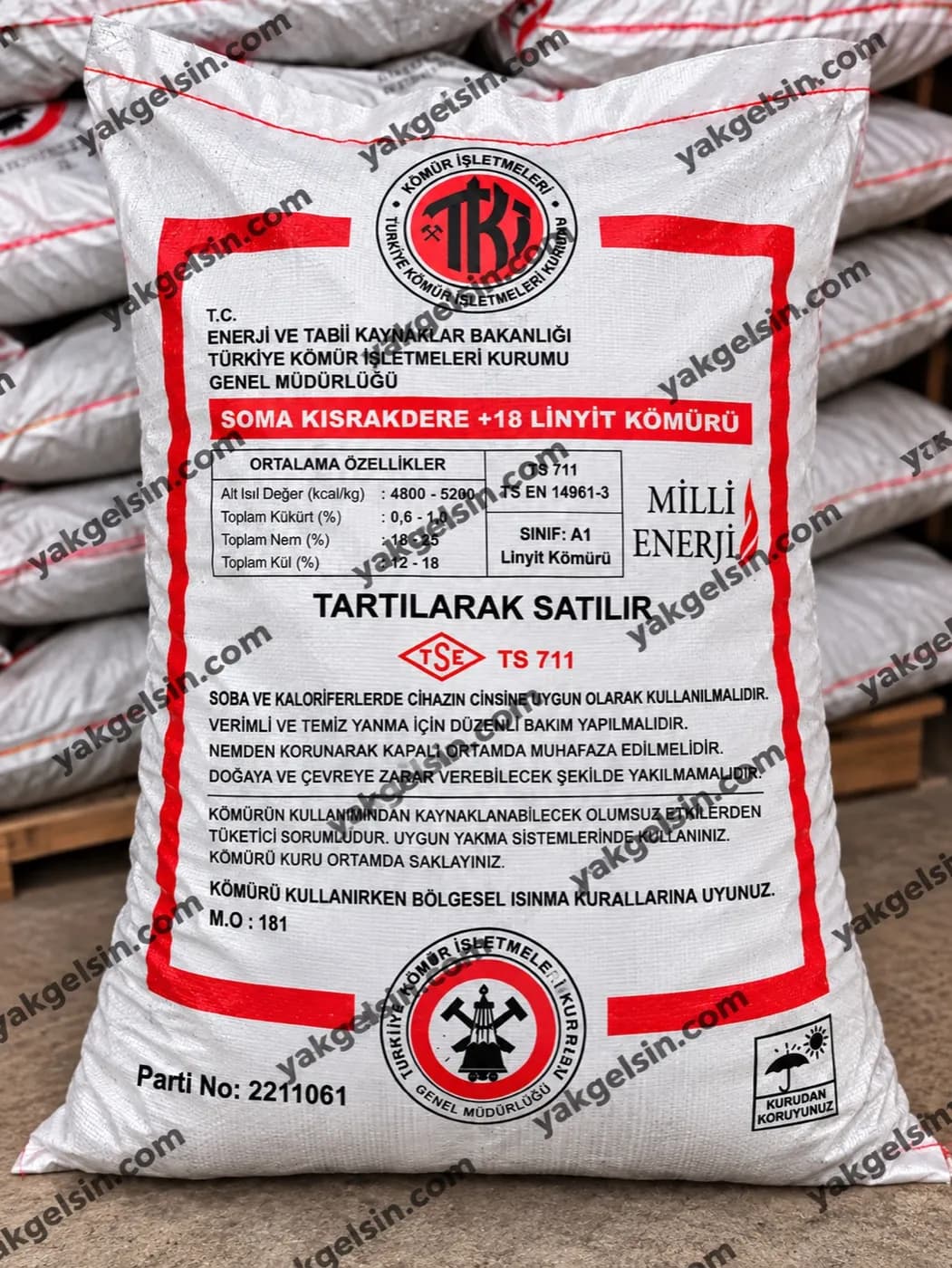
Producer: TKİ — Turkish Coal Enterprises · Type: Soma Kısrakdere +18 lignite
Calorific value (dry basis): 7800 - 8200 kcal/kg · Ash content: 7% - 9%
What does it depend on?
- The stove's air setting and flue draught
- The coal's heating value and moisture
- The home's heat loss and outdoor temperature
- Stove efficiency and how you load it
- How long and how the coal was stored
Safe burning and carbon monoxide
The Manisa Provincial Directorate of Environment says to fill the stove no more than halfway, light it from the top, never add fuel before going to bed and clean the chimney at least twice a year. The TKİ guide says not to add coal to a top-lit stove later, as carbon monoxide output would rise. No fuel is smokeless. Turkey's Ministry of Health describes carbon monoxide as colourless, odourless and poisonous; if in doubt, air the room and call 112. Fit a detector near bedrooms: carbon monoxide detectors and stove gas symptoms. For firing technique, see how to light a coal stove.
Frequently asked questions
How long does one bag of coal last?
It depends on how many hours a day you burn. A stove using 1 kg an hour for 10 hours a day uses 10 kg a day; a 25 kg bag is then about two and a half days of fuel (an assumed calculation).
How long can coal be stored?
The sources give no expiry period for household storage. Kept dry, covered and ventilated, losses are smaller; coal left in the open and in the rain loses value.
Can wet coal be burned?
Let coal with a wet surface dry first. Wet coal makes steam, and part of the heat goes into boiling off water.
Does coal turn into diamond if it sits?
No. What happens to coal sitting in a bag is oxidation and moisture change; its quality does not improve and may fall.
Sources: Manisa Provincial Directorate of Environment, Air Pollution Information Note; TKİ, Stove Coal Guide; HETAS, How to keep coal-based fuels dry; IEA Clean Coal Centre, Management of coal stockpiles (CCC/23); Aich, Nandi, Bhattacharya, Effect of weathering on an Indian thermal coal; US Bureau of Mines, RI 8474 Spontaneous Combustion Susceptibility of U.S. Coals; EIA, Glossary: Lignite; USFA, Heating fire safety; Ministry of Health, Carbon Monoxide Poisoning; CDC, Carbon monoxide basics.
Products in this article
- Süper Enerji Siberian CoalFrom, ₺375 excl. VAT, ₺450 incl. VAT
- Domestic Soma CoalFrom, ₺180 excl. VAT, ₺216 incl. VAT
- Block Coal (Large Lump)Price on WhatsApp
Current Price List
Starting prices for our coal, firewood and olive-pomace products: the amount excluding VAT, with the VAT-inclusive amount below it. Products without a listed price are quoted on WhatsApp.
| Product | Unit | Starting Price |
|---|---|---|
| Süper Enerji Siberian Coal | 25 kg bag | ₺375 excl. VAT, ₺450 incl. VAT |
| Domestic Soma CoalLimited stock | 25 kg bag | ₺180 excl. VAT, ₺216 incl. VAT |
| Cal Energy İmbat Coal — Grade 1Limited stock | 25 kg bag | ₺375 excl. VAT, ₺450 incl. VAT |
| Cal Energy İmbat Coal — Grade 2Limited stock | 25 kg bag | ₺350 excl. VAT, ₺420 incl. VAT |
| Cal Energy İmbat Nut Coal — Grade 1Limited stock | 25 kg bag | ₺375 excl. VAT, ₺450 incl. VAT |
| Cal Energy İmbat Nut Coal — Grade 2Limited stock | 25 kg bag | ₺350 excl. VAT, ₺420 incl. VAT |
| Central Heating Coal (Walnut Size)Made to order | — | Ask on WhatsApp |
| Central Heating Coal (Nut Size)Made to order | — | Ask on WhatsApp |
| Block Coal (Large Lump)Made to order | — | Ask on WhatsApp |
| Domestic Lignite Coal (Lump)Made to order | 25 kg bag | ₺160 excl. VAT, ₺192 incl. VAT |
| Root Coal (Domestic)Made to order | 40 kg sack | ₺290 excl. VAT, ₺348 incl. VAT |
| Pressed Coal (Briquettes)Made to order | — | Ask on WhatsApp |
| Oak Firewood (Dry) | 1 sack (20-25 kg) | ₺400 excl. VAT, ₺480 incl. VAT |
| Yellow Oak Stove Wood | Bagged — 30 kg | ₺400 excl. VAT, ₺480 incl. VAT |
| Red Oak Stove Wood | Bagged — 28 kg | ₺400 excl. VAT, ₺480 incl. VAT |
| Oak Firewood (6 Months Seasoned) | 1 sack (20-25 kg) | ₺400 excl. VAT, ₺480 incl. VAT |
| Yellow Oak Firewood (6 Months Seasoned) | 1 sack (20-25 kg) | ₺400 excl. VAT, ₺480 incl. VAT |
| 100% Pine Wood Pellets (ENplus A1) | 15 kg bag | ₺200 excl. VAT, ₺240 incl. VAT |
| Hazelnut Shell FuelMade to orderPrepaid | — | Ask on WhatsApp |
| Pine Kindling and Wood Pieces | Bag (17-23 kg) | ₺250 excl. VAT, ₺300 incl. VAT |
| Pirina (Olive Pit Fuel)Prepaid | 25 kg sack | ₺225 excl. VAT, ₺270 incl. VAT |
The top line of each price excludes VAT (+ VAT); the VAT-inclusive amount below it is what you pay. Prices can change. Message us on WhatsApp for the current price and a quote including delivery.
Ask for a Price on WhatsApp